
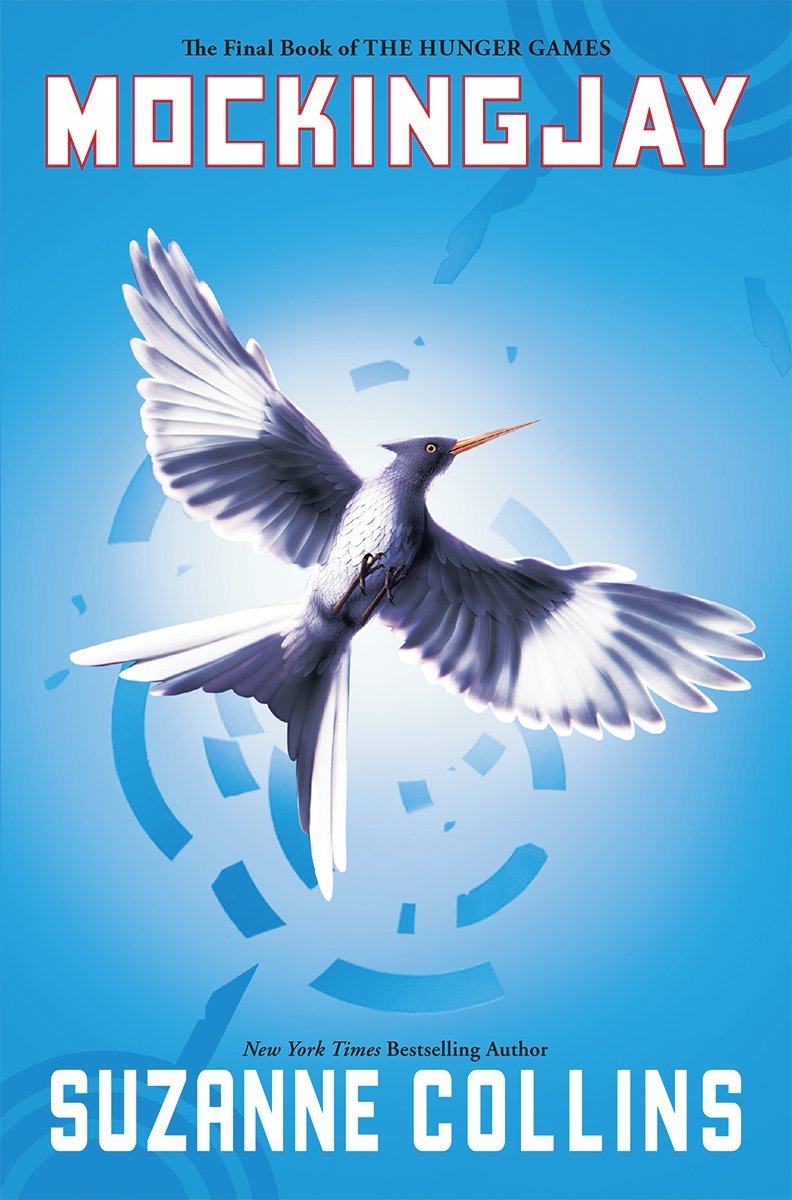
Mockingjay
‘What Collins does best in this novel is to make revolution seem anything but noble, clear-cut and easy.’
The first two books were a lead up to something and Mockingjay is that something and it's not pretty. Collins does not wish to offer another forum, another competition to readers. It's a war story and it's no exception to the rule that wartime stories have a heavy tone. The first picture is of Katniss standing in ruins of District 12. The story gets weightier; the casualties are more believable and there's no real happy or comfortable resolution in sight early in the book. I respected that decision, even though it made it very difficult to sit with in the book.
What Collins does best in this novel is to make revolution seem anything but noble, clear-cut and easy. Katniss isn't this shining beacon of righteousness. She's damaged, she's crying, she's psychologically damaged, and she knows everyone around has an agenda. The Capitol is out to kill her. District 13 is looking to rebrand her. The rebel movement desires her picture, her pain, her voice, on time and before a camera. The most ingenious ruse in the novel is that propaganda is a device that can be employed by both sides. They simply changed the banner, but they're still putting her in dresses, playing her and using her. The discomfort is felt throughout the book, and is what much of its strength comes from. The political density and subtlety here are greater than the earlier books and the issues raised are of real substance. Liberation but at what cost? Yes, a win, but whose? And most importantly, what happens to the person in the middle of a revolution when those around her don't see a human being anymore but a tool?
Katniss remains the main character of the trilogy. She's raw, in the inspirational sense of the word, and certainly not an emotionally calm woman. Hot-tempered, broken, single-minded, plagued with guilt and sometimes enigmatic: that's how she feels real. Collins has always understood that what makes Katniss a character is that she's not a pretty package. It's an essential quality in Mockingjay. She's lost, she's haunted by what's happened to Peeta, angry at what's happened to District 12, and she has to make decisions and do things that will impact the people all around her. This time the secondary characters need more from the reader as well. Gale becomes colder, dogmatic and in some ways, really disturbing. Peeta's arc is one of the saddest in the whole trilogy, and provides a lot of the book’s emotional punch. Even District 13 has its own character: all mundane, all disciplined, all under cover chilled. Secure and not very warm! Or free.
This is not flawless book, however. Collins is intent on making the horrors of war impossible to miss and sometimes it's a little too on-the-nose. The themes don't necessarily appear to have been worked into the story, but rather blasted through it in some places. There is also a slight shift in pacing after the fast-paced action of the first two books which may not be to some readers' liking. There's a lot of slower, more political, more emotionally dark and that's done on purpose, but it does mean that Mockingjay isn't as satisfying on a scene-by-scene level. Some of the plot points are underdeveloped, particularly towards the end, and some of the readers will find it very draining in the emotional aspect. This is good, as Collins isn't interested in shielding her characters (or her readers) from what war does to people, but a couple of the deaths here were more of a punishment than anything else: even with the bigger message of the book.
But Mockingjay is a novel that does what ending books don't do. Avoids taking the easy way out. It does not glorify violence, doesn't suggest that rebellion is a good thing, and doesn't provide a tidy and happy ending simply because the reader wants it. It does give, however, a quieter, more honest ending: it's a conclusion that feels earned. I don't know about you, but I didn't like the last couple of chapters but they were right. They allow survival without pretending survival erases damage. Mockingjay knows this all too well. Though the most difficult of the three books to enjoy unqualifiedly, it's a good conclusion to the trilogy. Dark, politically astute, emotionally draining and at times astounding. It's not the easiest of the series, but it is certainly the most grown up. I'd rate it as 4/5 stars.
From our readers
Reader Insights
Keep exploring
Similar reviews to explore
Catching Fire
The best thing about Catching Fire is that it's able to build upon the world of the first...
Sunrise on the Reaping
It was the tone of the first section in District 12 that attracted me to this, and was very...
Cryptid Carl and the Hollow King
Graves has also developed a rich folkloric ecosystem that does not serve just as scaffolding...