
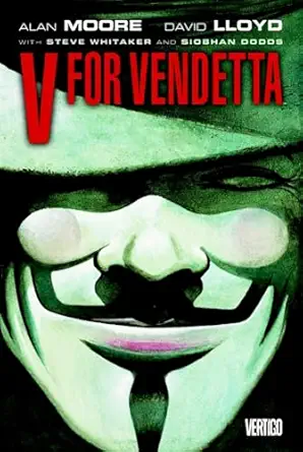

V for Vendetta
‘V for Vendetta presents a society that is under the oppression of surveillance, propaganda and fear.’
Set in an ugly future where England is under the control of a totalitarian fascist regime, V for Vendetta presents a society that is under the oppression of surveillance, propaganda and fear. It is about a mysterious, masked man named V, an anarchist revolutionary who combines theatrical spectacle and calculated violence to destroy the regime internally. V takes a young woman, Evey, whom he rescues, and brings her into his crusade, where she is taken through a series of psychological and physical tests aimed at breaking her addiction to authority and showing her the true price of freedom. Through their relationship, the novel dissects the cost of freedom and order, and shows the dangers of always keeping people terrified. V serves as a morally gray character. He is an executioner and liberator who kills elites and destroys government landmarks to create more freedom for the masses. The literature is dark-streaked and rough, which makes it both strange and compelling, especially as there are no certainties or heroism. As the old world eventually crashes down, there is no victory, only responsibility left behind.
The ability not to provide comfort or easy solutions is one of the best strengths of the novel. V for Vendetta questions the notion that leaders can ask people to give up freedom or that freedom can be attained without sacrifice. Rather, it claims that liberation is an internal process, the ability to think independently and hold oneself responsible for decisions. V is also willfully disturbing: he is intelligent, refined, charming, and frightening at the same time. He reveals the weaknesses of the conventional superhero myth by substituting moral purity with ideological belief. His deeds compel readers to pose unpleasant questions: is it ever possible to justify violence in the name of freedom and do the means of destroying tyranny justify the destruction of those who committed it? The story is emotionally centered around the change that Evey undergoes, and it is a painful experience of unlearning fear and reclaiming agency. Their relationship is not founded on love but on trauma and awakening, and it is one of the most disturbing and compelling relationships in graphic literature.
The depressing mood is supported by gloomy world-building and a broken narrative pattern. Life in the regime is suffocating not only due to physical surveillance but also due to psychological control. Citizens obey because they are scared and tired. This leads to a disturbing and unavoidable state collapse, showing that people's acquiescence feeds authoritarianism. Once that structure eventually collapses, the resulting mayhem highlights the unpleasant reality that liberty is much more terrifying than compliance.
The novel is challenging, although brilliant. The numerous supporting secondary characters, most of whom are members of various wings of the ruling government, can be hard to follow. The art style is dark and grainy and thematically correct but often makes characters aesthetically blurred, which makes it necessary to pay close attention to track political alliances and power plays. Also, the process of strict control being replaced by a state of social disorganization is fast, and there is not much time to investigate how ordinary citizens cope with the fact that authority disappeared overnight. The numerous philosophical monologues and ideological discussions can also be tedious and even overwhelming to readers who might want a traditional, quick-paced action novel.
In the end, V for Vendetta is most recommended to those who enjoy politically charged stories that do not comfort but provoke the assumptions of the reader. A four-star rating seems appropriate: the narrative is thought-provoking, emotionally disturbing, and thematically enduring, although the numerous characters and philosophical emphasis may be tiresome. The art can sometimes feel clogging, and the rhythm can be lumpy, but these weaknesses do not do much to mar its enduring strength. Its legendary main character, fearless concepts, and uncompromising vision make V for Vendetta an essential piece, one that does not only portray rebellion but also questions what exactly we are ready to lose in the name of freedom.
From our readers
Reader Insights
Keep exploring
Similar reviews to explore
107 Days
This book gives you a front row at the Vice President's house, where the biggest drama unfolds.
And Then There Were None
The novel explores the issues of guilt, justice and human nature, thus going beyond the limits...

Becoming Unstoppable
LaTrice explains that a confident person is always humble, conscious of himself, does not...